
On June 7th, 2022, Sumitra Peries joined us on Zoom to talk about being a filmmaker in the 20th century. Born just outside of Columbo in 1934, when Sri Lanka was still a British colony known as Ceylon, Peries became one of the country’s pioneering filmmakers. Her work is renowned for her realistic, sensitive portrayal of village life and her rendition of women’s experiences in rural, post-independence Sri Lanka*. In this interview, Peries details her working process, her experience as a woman filmmaker in Europe and Sri Lanka, how filmmaking and its meaning have changed over the decades, the current socio-economic climate in Sri Lanka, and what it was like making cinema with her husband, Lester James Peries**.
Le 7 juin 2022, Sumitra Peries nous a rejoints sur Zoom pour parler du métier de cinéaste au XXe siècle. Née juste à l’extérieur de Colombo en 1934, lorsque le Sri Lanka était encore une colonie britannique appelée Ceylan, Peries est devenue l’une des pionnières du cinéma du pays. Son œuvre est reconnue pour sa représentation réaliste et sensible de la vie villageoise et sa mise en scène des expériences des femmes dans le Sri Lanka rural d’après l’indépendance. Dans cette interview, Peries détaille son processus de travail, son expérience en tant que réalisatrice en Europe et au Sri Lanka, la façon dont le cinéma et sa signification ont changé au fil des décennies, le climat socio-économique actuel au Sri Lanka, et ce qu’était la réalisation de films avec son mari, Lester James Peries*.
Cinelogue: What made you interested in film in the first place? Was there any particular inspiration, a specific event that took place?
Sumitra Peries: I was born about 30 km from Colombo. So it was a bit of a suburb. When I was growing up, there was hardly any cinema, because all our films at that time were made in India. And we took the artists from Sri Lanka who had the same kind of South Indian style of acting. Sinhala was only a language then. All the styles of acting, the costumes, everything was South Indian. We only saw films by South Indian directors.
Rekava (1956, by Lester James Peries) was the first breakthrough. It was in 1952 or 1953 they started shooting. And Rekava still remains a beloved classic of our cinema. Of the history of our cinema. Lester is considered the father of Sinhala cinema because this was the first of ten big Sinhala films that was made in Sri Lanka at the time.
In 1956, I think, I met my husband for the first time. I didn’t know about his existence. I was at the embassy at that time in Paris when I was on vacation, and I knew the officer there, Mr. Vernon Mendis, and his wife. They knew I was a student. They came and picked me up and took me to their home, and then Lester came with the film. He also stayed there at their house, so we met there for the first time. It certainly wasn’t love at first sight, but anyway.
Cinelogue: Maybe second or third time then.
Sumitra Peries: Second or third. I got to know him as a person first.
At that time, I was a student, and I wanted to study cinema. I can’t understand how I wanted to do that. I wanted to go to IDHEC****, but unfortunately, they said I needed more French. I only had one year of French, I had studied at the École de Français Moderne at Lausanne University. When I came to IDHEC, they said I must do another year. Then Lester Peries came to Cannes and that was the first time I saw a Sri Lankan film, really. Because back home, I had only seen commercial Hindi or Tamil films from India. So he said, “Why don’t you go to England?”. I wasn’t very keen to go to England. I was keen to be in France. But finally, I went to the London School of Film Technique. At that time, it was in Brixton. And from the whole department and all the students, I was the only girl. I felt privileged at that time.
Lindsey Anderson and David Leans editor were some of the teachers. So I had a good background because of that. And then Lester was starting a new film. Set during the time of the Portuguese. So that was a big film. I got a message asking whether I would like to come to work. I had been in Europe for three or four years. I longed to come back home. So I came back and started working. I was assistant director to start with.
The second film was Gamperaliya (1963, Lester James Peries). And then I put some money in myself as I couldn’t get the right to do what I like to do otherwise. So I managed to get my finances right. I took to editing at a time when we used to edit the print, as you know. That means the sound was 19.5 frames ahead. When we had to adjust, we had to cut the negative because we couldn’t cut the married sound print when I started. There were no magnetic splicers to cut. We had to cut, scrape, and paste, which was a very tedious process. I have gone through all the processes in my career now. And now it’s electronic; with just a touch of a button, you have two shots put together. But in our day, we had to physically take one, hang it up, count the frames, and find the correct cutting point. I had installed an arriflex moviola movie lens in the house, so it became like a cottage industry, where I could spend plenty of time on the work irrespective of schedules and call sheets and all that. I could stay in the house; the fishmonger used to come to the house, and I would do my house chores and my editing too. That was the beginning, it was more of a cottage industry, but we made good films at the time.
There wasn’t any television like there is today. For my first film, called Gehenu Lamai (1978) — Girls — I wanted to find a girl to match that particular character. Vasanthi Chathurani became a star overnight. Even now, she is still very popular. She was a schoolgirl from a convent I picked up. A lot of newcomers have come through our stable because our style of acting was more restrained and more contemplative than the commercial films, South Indian films. I think Rekava has a little more activity than Gamperaliya. Gamperaliya is a quieter film, a family film. Even my Gehenu Lamai is about young love blossoming out in a village. So at that time, the films were very popular. And up until now, I think my reputation is still there.
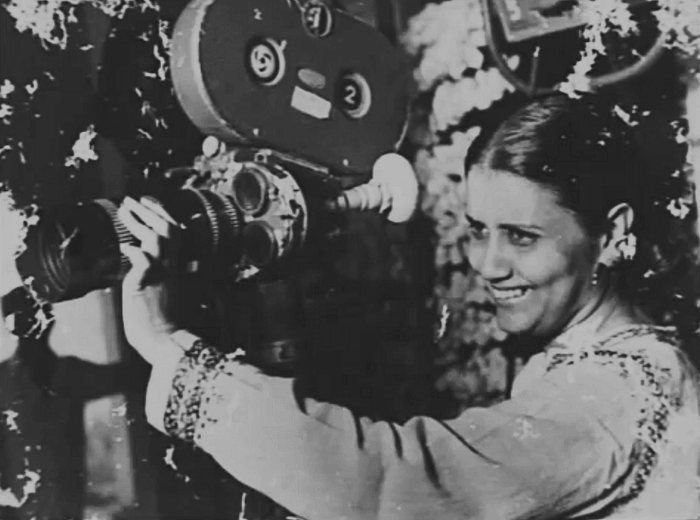
I have done ten films, not electronically but 35mm films on the old arriflex camera. The German camera has been our life friend. I had an arriflex editing machine, and I have worked all my life. Now I certainly might be the oldest living Sri Lankan filmmaker.
Even in this region, there aren’t very many film directors. I guess now more women get the chance to direct, but very rarely do you get a whole team that is female. France occasionally has a camera woman who comes with the team, or you get editors. Editing was considered to be a job that women could do. When they realized that the editor could make a difference to a film, they all got very greedy for the job. And men started pushing their way in. So I guess editing is very complex. It seems simple enough. But we couldn’t shoot very much film because at the time we only used about 20,000 feet of film. Not like Hollywood films. Here options were very small; you were restricted. You have very few choices when you’re brought into the editors’ scene. And you can’t change the rhythms much if the shots are not there. In my case, we also had to dub the sound because we couldn’t record direct sound; there were no facilities. It was a very primitive way of making films at that time.
But my last film, called Vaishnavee (2018) — I’d done the camera — was digital. I don’t think it made much of a difference. Of course, you could use many shots, but the more shots you had, the more choices. And then sometimes you took much longer to complete the film because of endless choices, and you play around a lot. You spend more time on location too; you even record the rehearsals. Because people are careless, they don’t memorize their passages as carefully. On film they know if they miss something, we lose a lot of money, but digitally people are much easier. They can get up in the next take. I have gone through the whole process from celluloid scratching and scraping and joining to cellotape and then now to digital. Any process is basically the same: Images are there, we play around with them. We don’t play, but we use them to express whatever we want to and players use the medium. I think I still prefer the skin tones of the 35mm film base over the digital image. The skin tones are much preferable for me.
But I guess if you ask me why I took to film…people think I took to film because my husband is a filmmaker, which is not true. I started studying films long before I came to know him. And I didn’t even know he was making his first film Rekava when I was in Europe studying. Like all young people, I was an adventurous young person. I lived on a yacht with my brother in the South of France for about six months. He, together with a French artist, who married an American girl, lived on a small yacht. I came and lived with them.
I came from a fairly political family. Not fairly, very. My father’s brother had been to America. He came back. They call him the father of socialism. He is Philip Gunawardena, who is very well known in this country, and I guess a lot of it may have rubbed off, the socialist part of it, maybe. The humanity, the kindness of human beings. So I feel I was privileged in the way I was born. But I haven’t abused it; I have used film to further whatever attitudes I had towards society, about people, friendship, relationships, and family. And then, of course, the haves and the haves not. But I don’t believe in using the medium of film as a political tool. Because I think it should be implicit, not explicit. I don’t believe in social slogans.
I guess my films have been gentler, and a lot of it has been — consciously by choice — female-oriented. My central characters have always been female, the mother, the sister, and the family in the village. About middle-class families, unfulfilled relationships, marriage. I have gravitated consciously or unconsciously toward the female of the species. Maybe because I am female, but basically, I didn’t go out to be didactic about the female situation. I was concerned about the anguish that a woman might go through due to social inhibitions due to social attitudes. Due to caste and class, all that has been my preoccupation. Most of my films have been concerned about the hardships a woman has to bear in our societies. I guess that would enliven some who have seen my films. I would have thought there would be empathy with me and what I had tried to say.
I’m not a social reformer, as such. But I am an emotional reformer up to a point. Emotionally I like to touch them in some way. To feel “what the hell, life is more than this.” I guess that has been my preoccupation. Hopefully, I have communicated that. Up until now, people had some respect and affection for me through my work more than anything else. Of course, I have a double reputation because my husband was also a very respected person and that naturally rubbed off. It has to rub off on me. But I guess I can stand on my own feet, and my films also mean something to our population. And even when my old films are played back, people remember the good old days.
I haven’t used songs in my films, except maybe one or two. But Lester didn’t use any. I think he stopped using the formulas of the Hindi, South Indian, and Indian film. The songs and the dancing were cut out very early. You have seen Rekava, you only see some little kids dancing a bit. But it’s the narrative and the people and the characters and the contemplativeness of those characters, about life itself. I think that enriches the onlooker to some extent. Maybe I would like to do some more work, but life doesn’t stay for you, you have to go with the age. Physically it’s so demanding that whether I will have the energy to do one, I’m not sure. I still hope to make something simple and very concentrated and contemplative. I would like to make one. But let’s hope I will have the energy to do it.Cinelogue: Could you share a bit more about your experiences as a female filmmaker, not only in Sri Lanka, but also as a student in the UK, as a woman, and as a Person of Color coming from Sri Lanka?
Sumitra Peries: Filmmaking is a tough job. In the beginning, it may have been too masculine, because you need muscle to lift the equipment and to work in the field. And I came from a fairly middle-class background. I guess for me to go at unusual times in vans with a lot of men wasn’t the most becoming thing for my family. But they didn’t object; they said I had earned my freedom by first going to Europe on my own against family objections. My mother died when I was young. If my mother lived, I might not have been able to become a filmmaker, I don’t know. But she was very conventional, she might’ve married me off if somebody proposed. And I might have agreed. I went to Visakha Vidyalaya, which was a very Buddhist school. Very conventional.
As I told you, my uncle came from a very socialist background. They started the socialist party in Sri Lanka. So they worked with the poor and the Malaria ridden people. I had social contact with that class of people very early in life. Maybe when I was a toddler, I might have known that a lot of people were there who had to go and help other people who were worse off. I’m mentally attuned to that kind of condition. My family also, my grandfather was supposed to be a very wealthy squire of that area. Until today, he’s very well known here. But also his son, when he was sent to America around the early 1900s, 1915, imbibed the socialist attitudes and came back to organize the trade unions. So I was used to my uncles being taken to jail by the British. What was right and what was wrong was well ingrained in me.
While filming, we didn’t have proper living conditions either, because when we were on location for six months I was in a village hut with coconut leaves thatched, not cemented floors. Those days we never scheduled, we just shot. We got up in the morning and when the sun was right, we shot. As a result, schedules took a long time. Today you go for 50 days or 35 days or whatever it is. At that time, filmmaking was a way of life. And we grew up in that atmosphere. I long for that. Because now it’s all schedules and call sheets to finish. At that time, we didn’t have any of that. We were very free. I had my own arriflex camera. We used to sit and wait for the right light. We used to wait for the crows to stop cawing and lit crackers to get rid of them, otherwise, we couldn’t record sound on location.
Filmmaking was really hard — physically much more demanding than today. Today you are kept in a hotel with an attached bathroom, which we couldn’t afford when we were young. We were put in a hostel or village hut, washed our faces down in the stream, and had a very basic toilet. You really had this lifestyle when you were a filmmaker at that time. Today, of course, it’s a lot more commercialized.
Today we have females coming into the industry, not in filmmaking, but mostly in television. We had that double difficulty because we wanted to make a particular type of film, and I was a female. So to make the kind of film I wanted to make, it was hard to get funding. The producer had to not care about the money but the prestige of making a film with so and so — I had that credibility. That made it possible to make films, along with a few moneyed people who came forward and supported me at that time. After the third or fourth film, I was bankable, and I could raise the money. Some of it I raised on my own. Some of the money from the banks has been paid back, and some of it hasn’t. All in all, I think I have loved what I have done. I love making films, and I think it awakened me. My whole psyche becomes alive when I talk about film because film is what we have lived. When I was married to Lester, we did nothing but talk about film.
We made films not to live, but films made us live. We never thought of making this film to bring us money or buy a house. None of those things were achieved. We just lived because we wanted to make films. And that feeling is still there.
It’s difficult now, of course, competition is heavier. Things are different.
Cinelogue: How do you feel about the title ‘the poetess of Sinhala cinema’ that people have given you?
Sumitra Peries: I think I was called the ‘poetess of sinhala cinema’ because my visual imagery was very put together. In the beginning, it was a disadvantage for me, because they felt I prettified everything. So I remember in my second film, I told my cameraman that I didn’t want to use the telephoto lens or any fancy camera movements. I wanted block lenses and to shoot it straight.
At the end of the day, once the film was shot and put together, it still had the same kind of rhythm, so I felt it was inbuilt in me. However much I tried to use technology to make it different, I couldn’t get away from it. Some people recognized that and started calling me the ‘poetess of Sinhala cinema’. Now they accept me for the way I see things and put them together — there is a rhythm and a poetry which comes from whatever technology I use, digital or 35mm block camera lenses.
Cinelogue: How do you feel about this term in general? I found that you and Lester James Peries were referred to as specifically portraying the Sinhalese family and Sinhalese culture. Does this title represent the diversity of Sri Lanka?
Sumitra Peries: It is the genre I know and the people I associate with. I did a film recently, the one before last, I believe, called Friends. It’s about a mixed marriage between a Sinhala father and a Tamil mother. From the viewpoint of the child growing up in two different cultures. It’s very subtle but still slightly different. That film was the only one where I attempted to do this. I took a South Indian actress and one little boy growing up with servants — one was a Muslim servant and the other a Tamil gardener. His friendship was with those people. So in a way, the different kinds of people of Sri Lanka were represented in that household — seen through the eyes of a child. It worked up to a point, but I think it became a little manipulative.
Cinelogue: Do you think formal independence from colonialism or colonial rule led to the freedom the people of Sri Lanka had hoped for at the time? Is this freedom reflected in the social and political life of Sri Lanka today?
Sumitra Peries: That’s a very complex question. I think people hoped for a more just society, but the British also divided and ruled, as they divided us more than anybody else possibly. Today, I think a lot of the issues are economic, and now, of course, the media is responsible for highlighting the divisions all the time.
People are getting very desperate because it’s not easy to be gentle when circumstances are hard. It is easy for me to sit there and share and say these things, but for people who have to live out there and find food for their families… things are not comfortable. And they blame everybody for it. That is intolerance. So religion and ethnicity come last of all. When you have one milk powder to share, it doesn’t matter what nationality or religion you are.
Cinelogue: What do you think is needed? Do you think we need a new wave of cinema, realist cinema, to depict today’s crises?
Sumitra Peries: I think I would prefer to go to a mythical cinema because you can create mythical characters who are essentially good people. Reality is so ugly now.
I like Superman and characters who symbolize the essential goodness of humanity without seeing life-like characters being horrible people. Because you wish people were kind and good. But if it’s not there, then let’s create a group of people, cardboard maybe, synthetic maybe. But if you know it’s synthetic, you only think of the values and not the personality, so I guess essentially, that should give you some good vibes. I hope.
Top Gun is making headway because, essentially, there is a different kind of film. I don’t quite understand or enjoy it, but I can understand why it’s there because reality is ugly now.
There is no poetry in reality anymore. There is only ugliness and wickedness. So you get a bit despondent. How can you paint a picture that is not there? You have to go to mythology or to a dreamworld with symbolic characters and maybe hope that we are doing something meaningful.
Cinelogue would like to thank Sumitra Peries for her time and for responding to our questions with such detail and acuity. The interview was conducted and written by Rehana Esmail and Priyanka Hutschenreiter.
*Sri Lanka gained independence from Britain on February 4th, 1948. The country would only become known as Sri Lanka in 1972 when it left the commonwealth and became a republic.
**Lester James Peries (1919–2018) is one of Sri Lanka’s most acclaimed filmmakers, known for his astute realism.
***Maria Schell (1926–2005) was an Austrian-Swiss actress, highly regarded in German cinema throughout the 1950s and 1960s.
****L’institut des hautes études cinématographiques (Institute for Advanced Cinematographic Studies). It is based in Paris and is now known under the name La Fémis.